Why every web design agency on the Costa Blanca builds the same website
Template swapped, colours changed, a few paragraphs written, live in three weeks. Six months later it looks like three of your competitors. Here's what's actually going wrong and what to do about it.
9 min read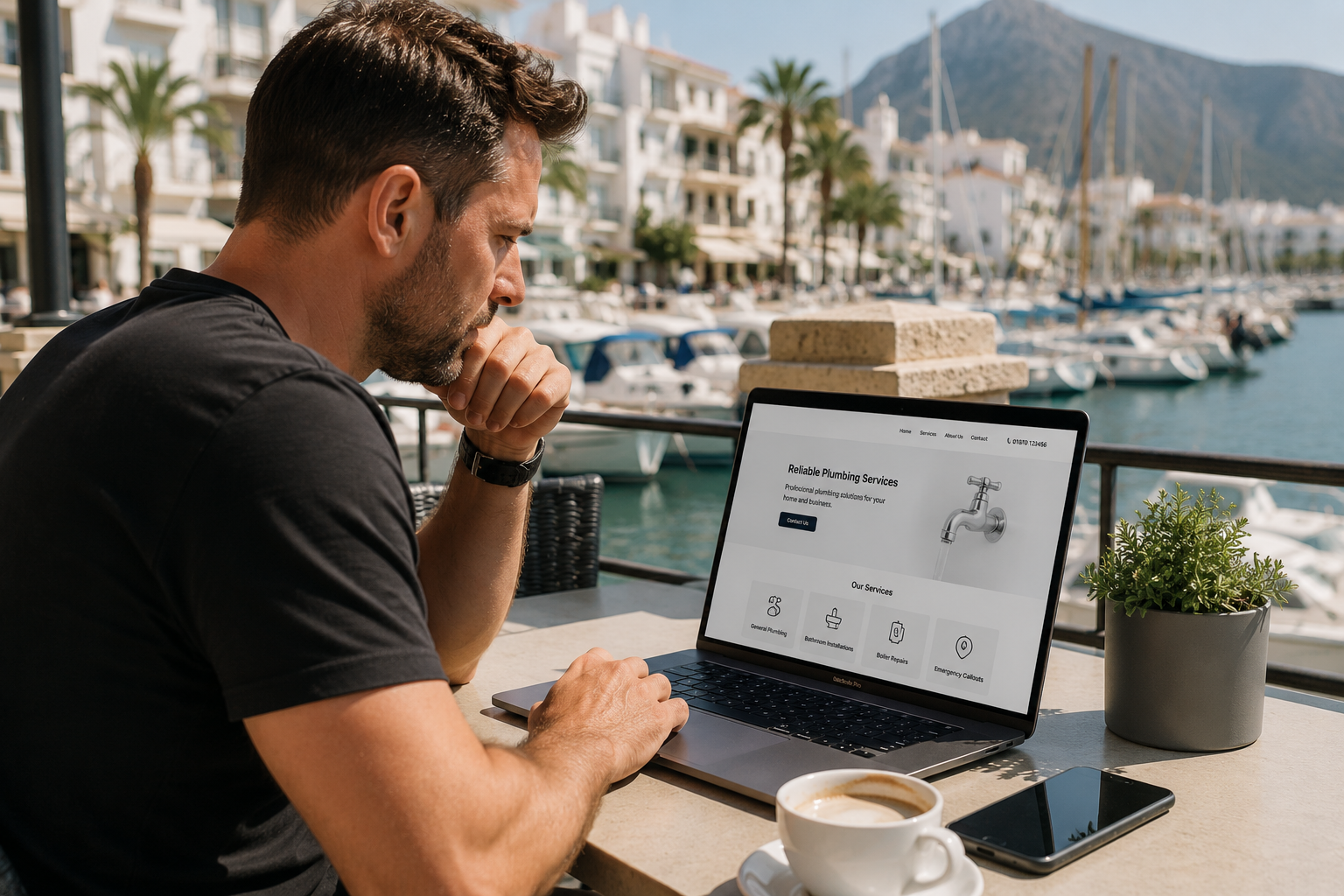
A website that looks like your three biggest competitors isn't a website. It's a missed opportunity wearing your logo.
You've probably already had the conversation. You speak to a local web designer. A template gets mentioned. A price gets quoted. A launch date gets promised, usually two or three weeks out.
The site goes live. It looks clean enough on day one. Then six months pass, and you notice something. Your website looks almost identical to two or three other businesses along the coast.
That's not a coincidence. That's what happens when a template gets recoloured and handed to whoever pays next. And on the Costa Blanca, where trust and differentiation matter more than almost anywhere else, that's a genuinely expensive mistake.
In this article:
The pattern almost every Costa Blanca website follows
Along the Javea to Denia corridor there's no shortage of people offering web design. But speak to a few of them and the conversation tends to sound remarkably similar every time.
A pre-made WordPress or Wix theme gets mentioned. The colours get customised to roughly match your brand. Your photos get dropped in. A few paragraphs of generic copy get written around them. The site goes live within two or three weeks.
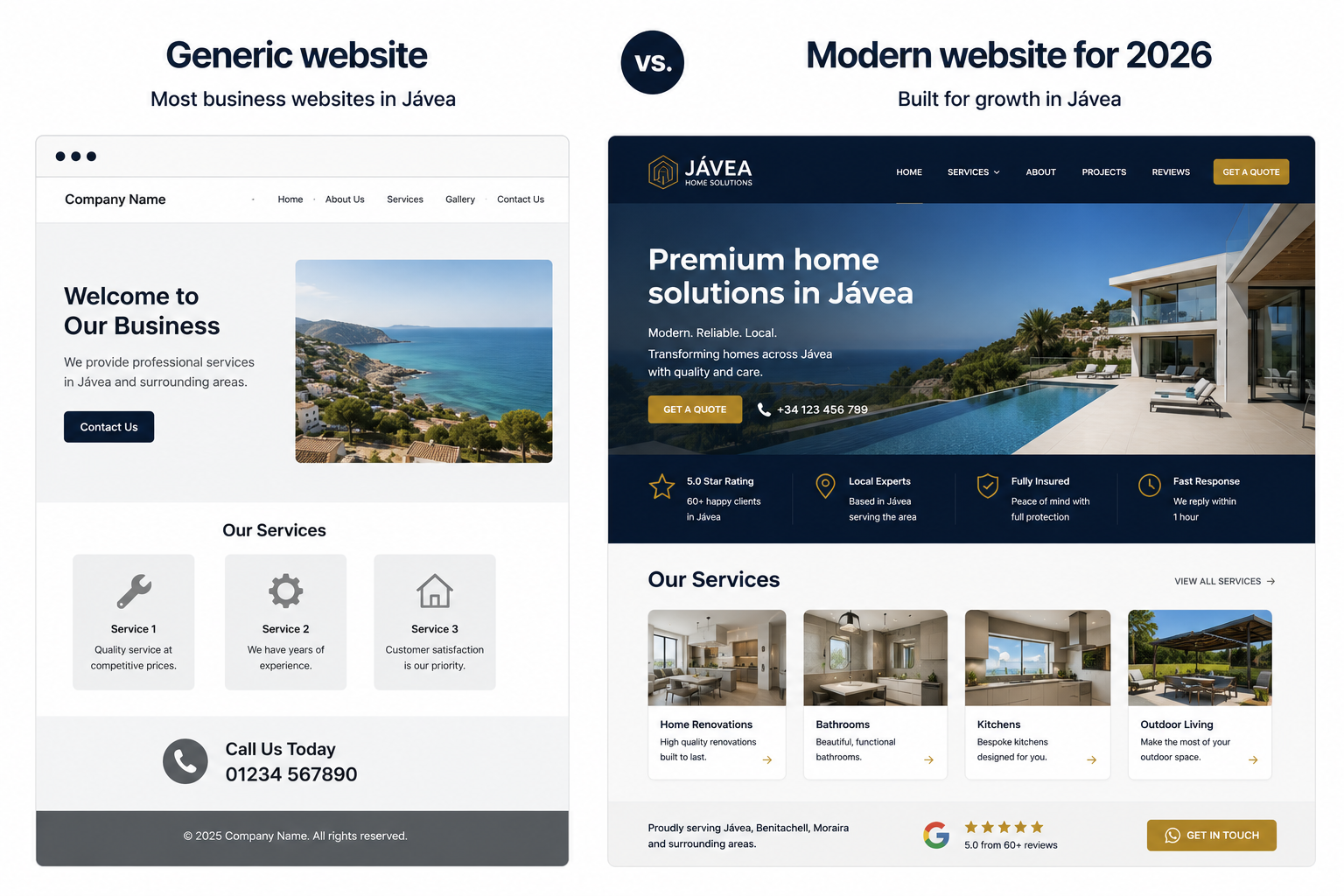
On launch day it looks perfectly professional. The problem shows up later. Because dozens of other local businesses went through the exact same process, with the exact same handful of templates, your site quietly starts to look like everyone else's. Same layout. Same structure. Same generic phrases about quality and experience.
That's not web design. That's mass produced with your logo stuck on top.
Why this hurts more in Javea specifically
Javea attracts a genuinely international, discerning audience. British, Dutch, German, and Spanish communities all live and do business here, alongside a strong seasonal flow of visitors and second homeowners comparing multiple providers before making contact.
That means customers here are, on average, doing more comparison shopping before they ever pick up the phone than in a lot of other markets. They're looking at two, three, sometimes four businesses side by side, often in a language that isn't even their first.
If your website looks identical to your competitors, you've handed that comparison over entirely to price and luck. There's nothing left to differentiate you the moment someone's looking at four near-identical sites in a row.
The multilingual problem nobody mentions upfront
Here's something most local web design conversations skip entirely. Javea has a huge international population, and a website built in only one language leaves a genuine amount of business on the table.
This isn't just about translation. It's about which language a potential customer feels comfortable enquiring in. A Dutch homeowner comparing local construction firms is far more likely to make contact with a business whose website speaks to them directly than one that requires them to read and enquire in a second or third language.
Most of the quick, templated builds along this coast are English only, or offer a bolted on translation plugin that reads awkwardly and clearly wasn't part of the original plan. That's a missed opportunity in a market where the international community is this large and this active. See how we build multilingual sites for the Costa Blanca
The seasonal trap most websites fall straight into
Javea's business rhythm isn't flat across the year, and a website that ignores this ends up working against you for months at a time.
Trade genuinely slows when the August heat hits, while tourism goes in the opposite direction entirely. A generic template with no thought given to this rhythm treats every month the same. No adjustment in messaging, no plan for capturing tourism-driven enquiries during the busy months, and no system keeping leads warm during the quieter trade periods.
A website built with this seasonality in mind works with the local rhythm instead of against it, whichever side of that cycle your business sits on.
What a Javea business actually needs from its website
Multilingual by default, not bolted on as an afterthought. English, Dutch, and Spanish at minimum, depending on your specific customer base.
Real local trust signals rather than generic stock photography and made up testimonials. Genuine reviews, genuine local work, genuine credibility that a comparison-driven customer can actually verify.
A structure built around the two industries currently booming here, real estate and construction, both of which are seeing brutal competition right now and need a website that clearly sets the business apart rather than blending into the same crowded field. Read our guide on choosing a web design agency properly
And a system that keeps capturing and following up on enquiries even during the quieter trade months, so a seasonal dip in local work doesn't mean a seasonal dip in the pipeline. Read more about automating your follow-up
How this fits into a proper system
A genuinely differentiated, multilingual website is the starting point. But on a coast this competitive, it needs to be backed by proper local SEO, a strong review profile, and a system that follows up automatically, especially given how much of the buying decision here happens through comparison before anyone makes contact. Read our full local SEO guide for how the pieces fit together
This is exactly what we build for businesses across Javea and the wider Costa Blanca. A website that doesn't look like the one down the road, built multilingual from day one, connected to a system that keeps working through the quiet months as well as the busy ones.
See how the Growth System is built for this market
"A template gets recoloured and handed to whoever pays next. Six months later it looks like three other businesses on the same stretch of coast. That's not a website. That's a missed opportunity wearing your logo."
Key takeaways
- Most Costa Blanca web design follows the same pattern: a recoloured template, a few paragraphs of copy, live in weeks, and identical to competitors within months
- Javea's international, comparison-driven customer base makes differentiation matter more here than in most markets
- A one-language website genuinely loses business in a market with a large Dutch, German, British, and Spanish population comparing local providers
- Javea's business rhythm shifts sharply between quiet August trade and high tourism demand, and a generic website ignores this completely
- A genuinely differentiated, multilingual website backed by local SEO and automated follow-up outperforms a templated site every time in this market

Shaun Chrisp
Founder, Chrisp Design
Shaun has spent over a decade helping local businesses grow with smarter marketing systems. Chrisp Design builds websites, AI systems and automation for businesses across the UK and Costa Blanca.