- System
Growth System
Missed Call Text Back
Never lose a lead to a missed call again.
Customer Reactivation
Turn your old customer list into new bookings & reviews.
AI Receptionist
Automate your customer service & admin.
Google Reviews
Automate your 5-star review collection.
Booking System
Automate your calendar and appointments.
All-In-One Inbox
Every conversation in one single place.
Email Marketing
Automated follow-ups and newsletters.
Areas we cover
North East
Across the North East, town by town.
Newcastle
Web design for Newcastle trades.
Northumberland
Websites for Northumberland trades.
Sunderland
Web design for Sunderland trades.
Durham
Web design for Durham trades.
Gateshead
Web design for Gateshead trades.
Cramlington
Our home town. Local web design.
Blyth
Web design for Blyth trades.
Bedlington
Web design for Bedlington trades.
Ashington
Web design for Ashington trades.
Morpeth
Web design for Morpeth trades.
Ponteland
Web design for Ponteland trades.
Killingworth
Web design for Killingworth trades.
- Blog
Recent posts
Why your best customers never leave a review
Reviews
The hidden cost of one missed call
Missed Calls
What your business is worth without you in it
Business Ownership
Why the first message never wins the job
Follow Up
Backlinks vs reviews vs on-page SEO
Local SEO
Web design Cramlington: built for how locals actually buy
Web Design
Why Costa Blanca websites look identical
Web Design
Get found on ChatGPT and AI
Local SEO
How to choose a web design agency
Web Design
How to reduce no-shows
Systems & Automation
- About
- Contact
How to get your local business found on ChatGPT, Claude and Gemini
People are asking AI assistants for local recommendations instead of Googling them. If your business isn't set up to be found, you're invisible to a growing part of your market. Here's exactly how AEO works, explained simply.
By Shaun Chrisp, founder · Published · Updated
11 min read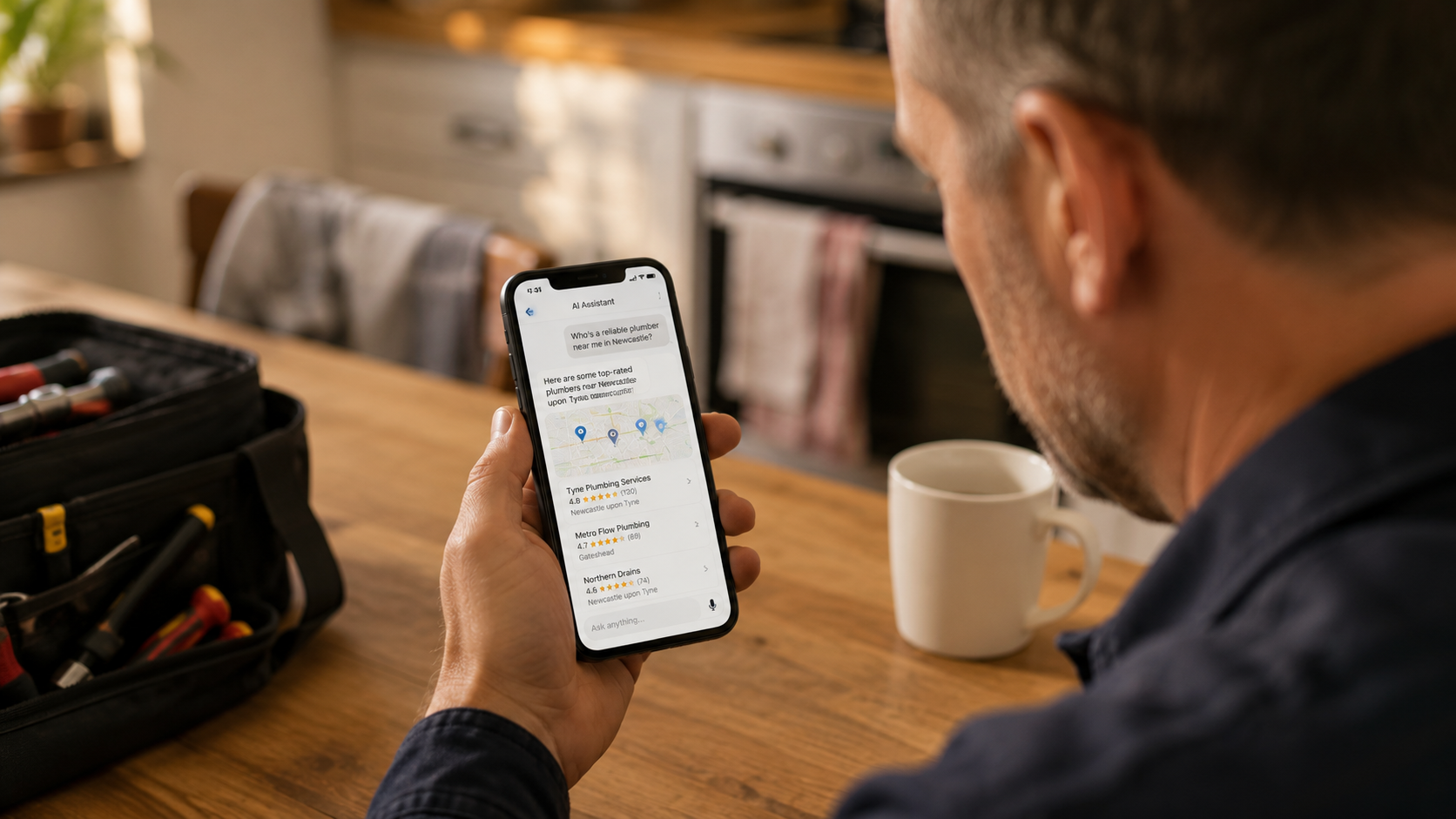
If your business isn't part of the answer an AI gives, you don't just rank lower. You don't exist for that customer at all.
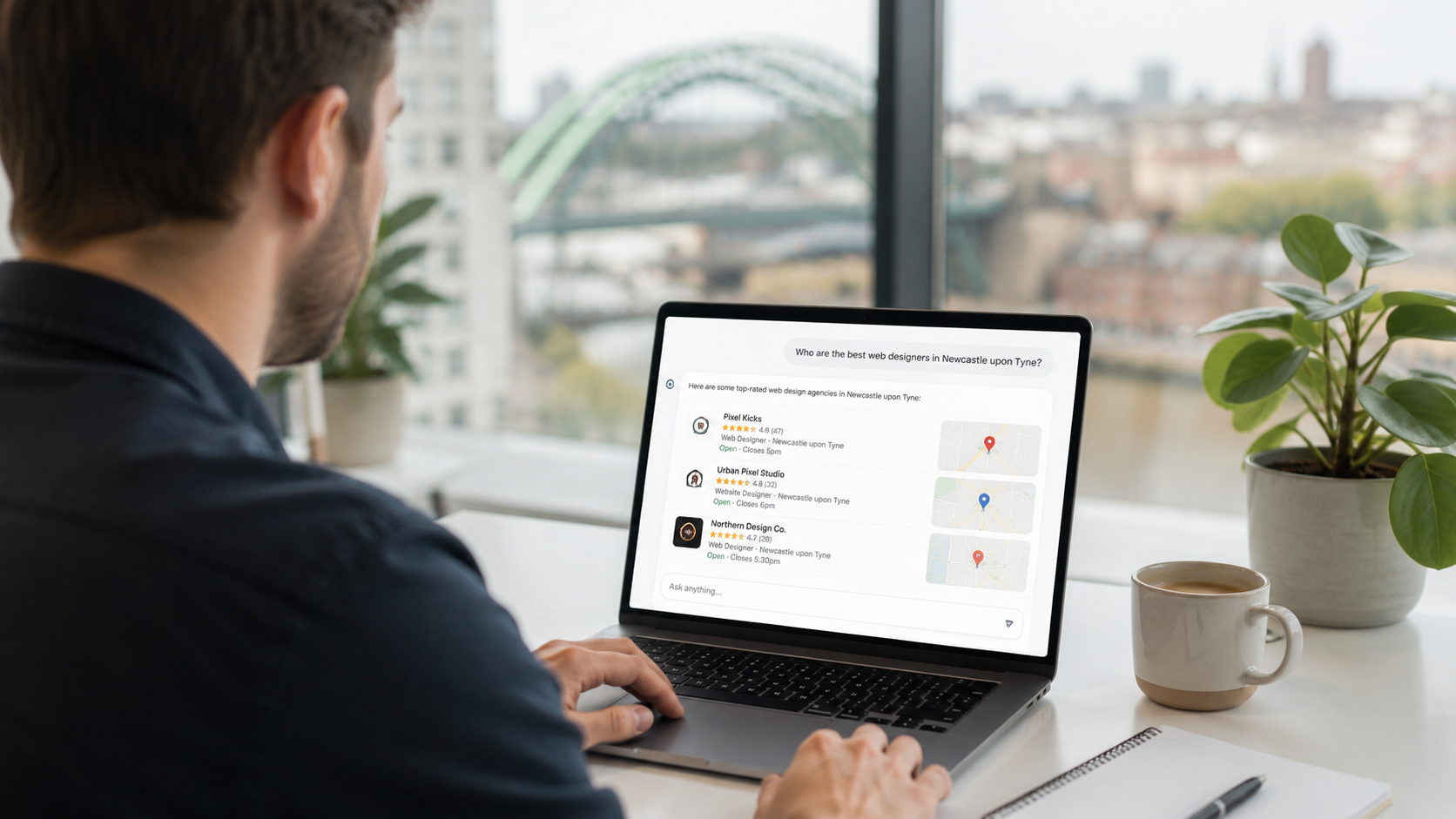
Google isn't the only place people are searching anymore. Someone needs a plumber. Instead of Googling it, they open ChatGPT and type "who's a good plumber near me in Newcastle." Someone's looking for a web designer. They ask Claude to compare a few local agencies.
This is happening right now. Not in five years. Right now, in 2026.
And here's the uncomfortable truth. If your business isn't set up to be found and recommended by AI tools, you're invisible to a growing chunk of your potential customers. Not ranked lower on a page. Invisible. Not mentioned at all.
This guide explains exactly what's happening, why it matters, and what you can actually do about it. No jargon. No assuming you already understand SEO. Just plain English.
In this article:
- Quick summary if you're short on time
- What is AEO?
- Why this is happening right now
- How AI tools actually decide who to recommend
- Why most local businesses are currently invisible to AI
- The six things that actually help a local business get found by AI
- How AEO connects to everything else in local SEO
- A simple way to check where you currently stand
- What this means for the next few years
- How we're building AEO into the Growth System
Quick summary if you're short on time
People are starting to ask AI tools like ChatGPT, Claude, and Gemini for local business recommendations instead of using Google search. These AI tools decide who to recommend based on how clearly and consistently a business describes itself online. Most local businesses aren't set up for this at all. The businesses that get their basics right now, while almost nobody else is thinking about it, will have a serious head start over the next few years.
If you want the full picture, keep reading.
What is AEO?
AEO stands for Answer Engine Optimisation.
You've probably heard of SEO, which stands for Search Engine Optimisation. That's the work that gets your website showing up in Google's list of results when someone searches for something.
AEO is the same idea, but for a different kind of search. Instead of getting your website to rank in a list of ten blue links, AEO is about getting your business mentioned directly inside the answer an AI assistant gives someone.
Here's the difference in plain terms. With Google, someone searches "plumber Newcastle" and gets a page of ten results. They scroll, compare, click a few, and pick one. With an AI assistant, someone asks "who's a good plumber in Newcastle" and gets one confident answer, maybe with two or three businesses mentioned. There's no scrolling. No page of options to compare. Either you're in that answer or you're not.
That's what makes AEO different, and why it matters so much.
Why this is happening right now
A few years ago, AI chat tools like ChatGPT could only answer questions using what they'd learned during training. They couldn't search the internet in real time. That's changed completely.
Now, tools like ChatGPT, Claude, and Gemini can search the live internet, read current websites, check reviews, and pull in up-to-date information before giving an answer. That means when someone asks for a local recommendation, the AI isn't just guessing from old data. It's actively looking at what's available right now, today, about businesses in your area.
This is exactly why AEO matters in 2026 in a way it simply didn't two years ago. The tools got smarter, and people started trusting them more. Millions of people now use AI assistants daily, for all sorts of questions, including "who should I hire for this job near me."
How AI tools actually decide who to recommend
This is the part most local business owners have never thought about.
When someone asks an AI assistant for a local recommendation, the AI doesn't just make something up. It pulls information from a mix of sources to build its answer.
Its training data
This is the huge amount of text the AI learned from before it was ever released, including articles, websites, and other content about businesses across the internet.
Live web searches
Many AI tools now search the internet in real time while answering your question, similar to how Google works, but summarised into one direct answer instead of a list of links.
Structured data
This includes things like your Google Business Profile, review platforms like Trustpilot or Checkatrade, and any part of your website that's coded in a way that clearly tells search engines exactly what your business is and does.
Put simply, the AI is trying to give a confident, accurate, helpful answer. To do that safely, it needs to be sure about who it's recommending. A business that's easy to understand, consistently described, and backed up by real reviews is a safe, easy recommendation. A business that's vague, inconsistent, or hard to pin down is a risk the AI would rather avoid.
Why most local businesses are currently invisible to AI
Picture a typical local business website. A homepage with a big header image and a phrase like "Quality you can trust" or "Excellence in every job." A short "About Us" paragraph. A services page that lists things in a bulleted way but doesn't explain them clearly. No mention of exactly which areas are covered. No clear pricing or process explained anywhere.
Now imagine you're an AI trying to answer "who's a reliable electrician in Morpeth that does emergency callouts." You land on that website. You can't quickly tell if they do emergency callouts. You can't tell if Morpeth is even one of the areas they cover. There's nothing clearly stating what makes them different or trustworthy.
So the AI moves on. It finds a different business whose website says clearly, in plain language, "We are an electrical contractor based in Morpeth covering Northumberland, offering same-day emergency callouts 24 hours a day." That business gets recommended. Yours doesn't. Not because your work is worse. Because your website never gave the AI a clear, confident answer to work with.
This is the exact same problem that's held businesses back in Google search for years. AEO just makes it more extreme, because there's no page two to fall back on anymore.
The six things that actually help a local business get found by AI
1. Clear, factual content instead of vague marketing language
AI tools respond best to plain, factual statements. Compare these two sentences.
"We are passionate about delivering excellence in everything we do."
"We are a plumbing company based in Cramlington covering Northumberland, specialising in boiler repairs, bathroom installations, and emergency callouts."
The first sentence tells an AI nothing useful. The second one tells it exactly who you are, where you work, and what you do. Every page on your website should read more like the second example.
2. Schema markup
This one sounds technical but the concept is simple. Schema markup is a bit of hidden code added to your website that explicitly labels information for search engines and AI tools. It tells them, in a language they understand perfectly, things like your business name, address, phone number, opening hours, services, and review ratings.
Without schema markup, an AI has to try and work out this information by reading your page like a human would, which leaves room for mistakes or gaps. With schema markup, there's no guessing involved. It's stated in black and white. This is one of the single biggest technical advantages a website can have for AEO. We build schema markup into every website
3. A strong, consistent, recent review profile
Reviews matter enormously here, arguably even more than they do for traditional SEO. Reviews are written by real people, which makes them one of the strongest trust signals an AI can use. A business with 60 recent, positive reviews is a far safer recommendation than a business with three reviews from four years ago, or no reviews at all.
If your review profile is thin or outdated, you're making it much harder for an AI to confidently recommend you, even if your actual work is excellent. Read our full guide on getting more Google reviews
4. Consistency everywhere your business is mentioned
Your business name, address, and phone number need to match exactly across your website, your Google Business Profile, directories like Yell or Checkatrade, and your social media pages.
If your address says "12 High Street" in one place and "12 High St" in another, that's a small thing to a human but it creates doubt for an AI trying to confirm exactly who you are and where you're based. Consistency removes that doubt entirely.
5. FAQ style content that mirrors real questions
AI tools are, at their core, built to answer questions. A website with a clear FAQ section, written in the same language customers actually use, is far easier for an AI to pull useful answers from than a page of generic service descriptions.
Questions like "how much does a boiler service cost in Newcastle" or "do you offer same-day emergency plumbing" give an AI exact, ready-made answers it can use directly. This is one of the easiest wins on this entire list.
6. Being mentioned consistently across the wider internet, not just your own website
AI tools don't only look at your website. They draw on directories, local news mentions, community pages, industry bodies, and anywhere else your business might be described online.
This works the same way backlinks work for traditional SEO. The more places your business is accurately and consistently mentioned, the stronger the overall signal that you're a real, established, trustworthy business worth recommending. Read our guide on backlinks and why they matter
How AEO connects to everything else in local SEO
Here's the good news buried in all of this. AEO isn't some brand new, separate discipline you need to learn from scratch. It's built on exactly the same foundations as good local SEO.
A fast, clearly written website. A fully completed, active Google Business Profile. A steady stream of recent, genuine reviews. Consistent business details wherever you're listed online. Content that answers real customer questions in plain language.
If you've already been doing local SEO properly, you're most of the way there already. If you haven't, the good news is fixing it helps you in both places at once, traditional Google search and AI recommendations. Read our full local SEO guide for the fundamentals
A simple way to check where you currently stand
Try this yourself. Open ChatGPT, Claude, or Gemini and ask a question a potential customer might genuinely ask. Something like "who's a good [your service] in [your town]."
See what comes back. Is your business mentioned at all? If a competitor is mentioned and you're not, look at their website and Google profile compared to yours. Are they clearer? Do they have more reviews? Is their information more consistent?
This single exercise will show you exactly where the gaps are, in minutes, for free.
What this means for the next few years
This shift is only going in one direction.
More people are turning to AI assistants as their first stop for recommendations instead of a traditional search engine. Every major AI platform is investing heavily in real-time web access and local business data. That trend isn't slowing down. If anything, it's accelerating faster than most local business owners realise.
The businesses that take AEO seriously now, while almost none of their competitors have even heard the term, are the ones who will dominate this channel by the time everyone else catches up. This is exactly the position local SEO was in roughly ten years ago. The businesses that took it seriously early built an advantage that's still paying off for them today. AEO is that same window of opportunity, right at the very start.
How we're building AEO into the Growth System
At Chrisp Design, we've already started building AEO principles directly into every website and system we deliver, not as an afterthought but as a core part of how we build.
That means clear, factual page content written in plain language instead of vague marketing fluff. Proper schema markup coded into every page, so AI tools never have to guess who you are or what you do. FAQ sections built around the real questions your customers actually ask. Consistent business details set up correctly across every platform we manage for you. Automated review generation that keeps your profile strong, recent, and trustworthy.
This isn't a separate service you need to buy on top of everything else. It's built directly into the Growth System from the ground up, because it's simply what a properly built local business system looks like in 2026.
You're not just getting a website built for Google anymore. You're getting a system built for however people are actually searching, whether that's Google, ChatGPT, Claude, Gemini, or whatever comes next.
See how the Growth System is built for what's next
"AEO isn't a separate strategy. It's what happens when local SEO is done properly and applied to a world where people ask an AI for a recommendation instead of scrolling through search results."
Key takeaways
- AEO (Answer Engine Optimisation) is about getting your business recommended directly inside AI answers, not just ranked in a list of links
- AI tools like ChatGPT, Claude, and Gemini decide who to recommend based on clarity, consistency, and structured data, not guesswork
- Most local business websites are too vague and inconsistent to be confidently recommended by an AI assistant right now
- Six things matter most: clear factual content, schema markup, strong recent reviews, consistent business details, FAQ style content, and consistent mentions across the wider internet
- AEO is built on the same foundations as good local SEO, so improving one improves the other
- You can check your own visibility right now for free by asking ChatGPT, Claude, or Gemini who they'd recommend for your service in your area
- Getting ahead of AEO now, while most competitors haven't heard of it, creates a lasting advantage similar to early local SEO adoption a decade ago

Shaun Chrisp
Founder, Chrisp Design
Shaun has spent over a decade helping local businesses grow with smarter marketing systems. Chrisp Design builds websites, AI systems and automation for businesses across the UK.
Find our guides useful? Add Chrisp Design as a preferred source on Google to see more of our articles in your search results.
Add as preferred source on Google