- System
Growth System
Missed Call Text Back
Never lose a lead to a missed call again.
Customer Reactivation
Turn your old customer list into new bookings & reviews.
AI Receptionist
Automate your customer service & admin.
Google Reviews
Automate your 5-star review collection.
Booking System
Automate your calendar and appointments.
All-In-One Inbox
Every conversation in one single place.
Email Marketing
Automated follow-ups and newsletters.
Areas we cover
North East
Across the North East, town by town.
Newcastle
Web design for Newcastle trades.
Northumberland
Websites for Northumberland trades.
Sunderland
Web design for Sunderland trades.
Durham
Web design for Durham trades.
Gateshead
Web design for Gateshead trades.
Cramlington
Our home town. Local web design.
Blyth
Web design for Blyth trades.
Bedlington
Web design for Bedlington trades.
Ashington
Web design for Ashington trades.
Morpeth
Web design for Morpeth trades.
Ponteland
Web design for Ponteland trades.
Killingworth
Web design for Killingworth trades.
- Blog
Recent posts
Why your best customers never leave a review
Reviews
The hidden cost of one missed call
Missed Calls
What your business is worth without you in it
Business Ownership
Why the first message never wins the job
Follow Up
Backlinks vs reviews vs on-page SEO
Local SEO
Web design Cramlington: built for how locals actually buy
Web Design
Why Costa Blanca websites look identical
Web Design
Get found on ChatGPT and AI
Local SEO
How to choose a web design agency
Web Design
How to reduce no-shows
Systems & Automation
- About
- Contact
A simple marketing plan for trade businesses: five steps, no fluff
One month flat out, the next staring at a quiet diary. That's not a skills problem, it's a system problem. Here's how to fix it in five straightforward steps.
By Shaun Chrisp, founder · Published · Updated
7 min read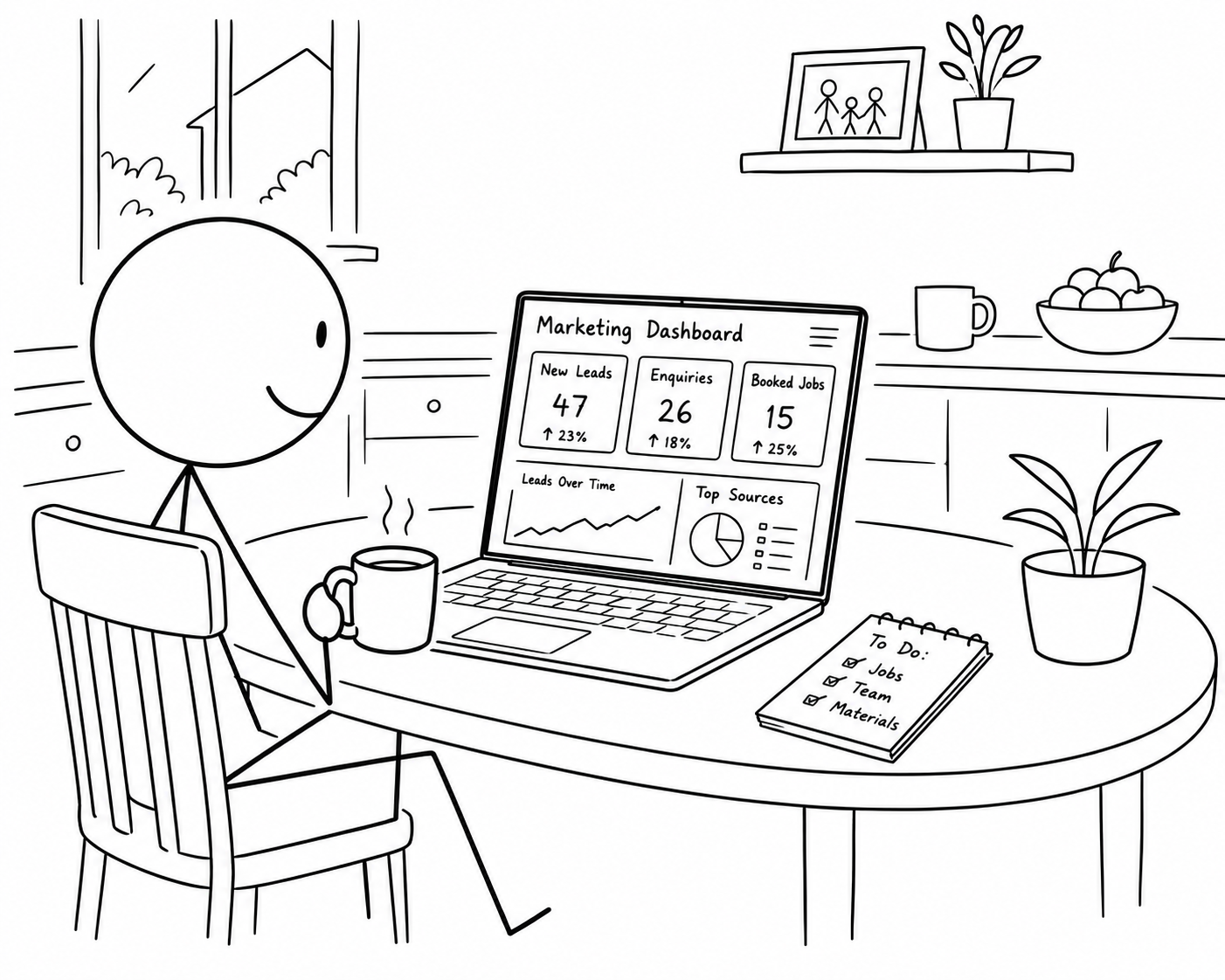
The trades businesses with full diaries aren't the most skilled ones. They're the ones with a system.
One month you can't keep up. The next you're waiting for the phone to ring. That's not a skills problem. That's a system problem.
Most trades have no marketing plan at all. They rely on word of mouth, the odd Facebook post, and hoping Google shows them to the right people. When it works, it works. When it doesn't, you're staring at a quiet diary wondering what happened.
A proper marketing plan isn't complicated. It's five things, done consistently, in the right order. Here's what it looks like.
In this article:
Step 1: get clear on who you actually want to work for
Most trades try to appeal to everyone. Any job, any area, any budget.
That's the fastest way to stay average.
The trades businesses that grow quickly, and stay busy, know exactly who their best customer is. Not vaguely. Specifically. Which type of job. Which type of area. Which type of customer pays well, doesn't haggle, and leaves a good review.
Think about the last five jobs you genuinely enjoyed. What did they have in common? That's your target customer.
Everything in your marketing, your website, your Google profile, your ads, should speak directly to that person. When you try to speak to everyone, you end up connecting with no one.
Step 2: master one lead source before you touch another
This is where most trades waste money.
They run Google Ads and Facebook Ads at the same time. They're posting on Instagram, sending emails, trying to get on Checkatrade, and wondering why none of it is working properly.
Pick one. Get really good at it. Then add another.
For most local trade businesses the place to start is your Google Business Profile. It's free. It's where people go when they're ready to book, not browsing, not just looking, actually ready to pick up the phone.
Get your profile fully set up. Regular photos. Regular posts. Respond to every review. Keep your information accurate.
When that's generating consistent enquiries, then you add the next thing. Not before.
Step 3: make an offer worth responding to
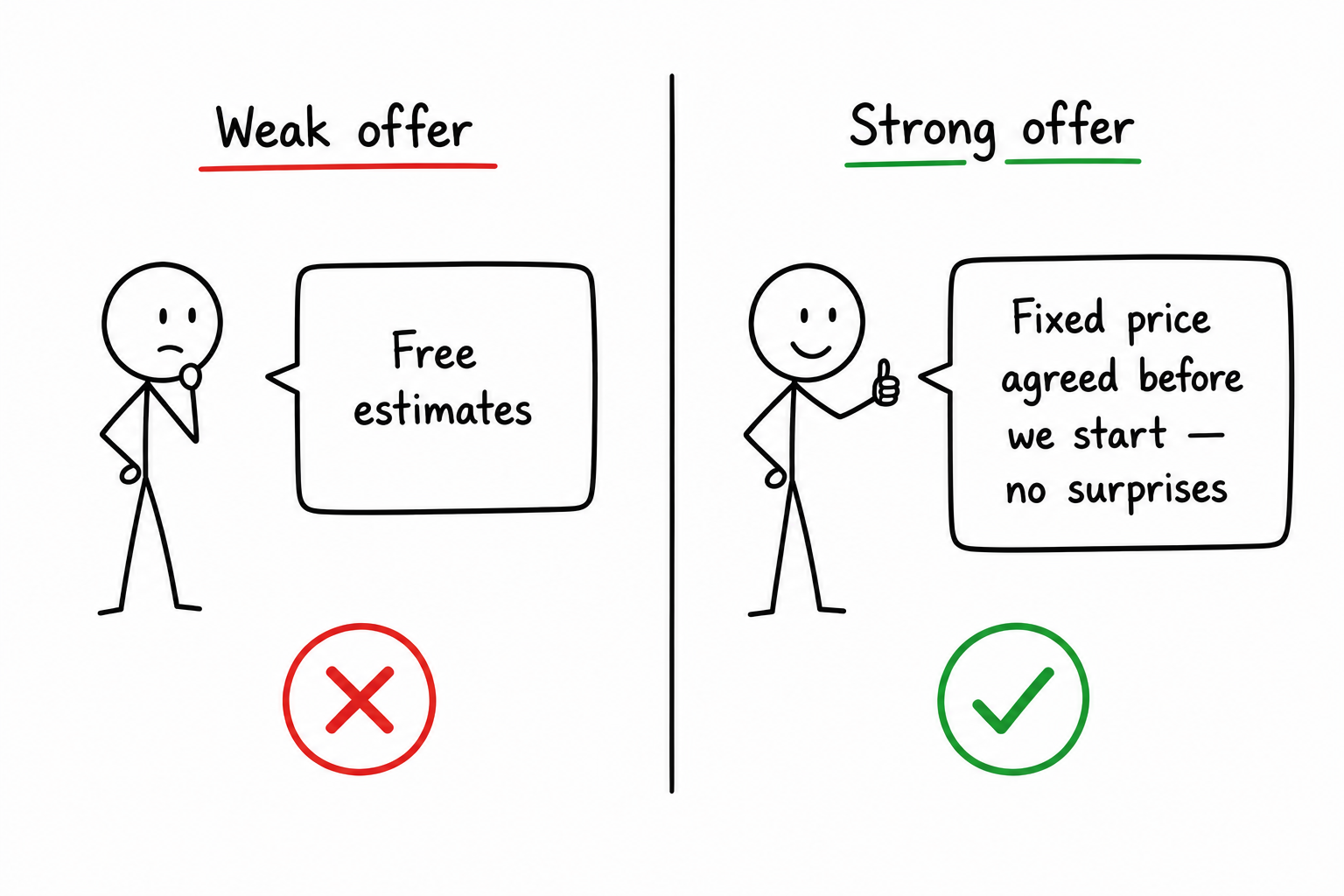
"Free estimates" is not an offer. Every trade gives free estimates. It means nothing.
Your offer should do two things: solve a specific problem and reduce the customer's risk.
Think about what your best customers are actually worried about. They've been let down before. They don't know if you'll show up on time. They don't know if the price will change halfway through.
An offer that addresses that directly is worth ten times more than a generic "call us today."
Something like "Same-day quote guaranteed" or "Fixed price agreed before we start, no surprises" speaks to a real concern. That's what makes someone choose you over the three others they've called.
Step 4: build your review engine
Most people won't hire a trade business without checking reviews first. That's just the reality now.
One bad review from three years ago and a thin profile isn't good enough. You need recent reviews, coming in steadily, from real customers.
The problem is asking for reviews manually is awkward and inconsistent. You remember sometimes. You forget others. Some customers mean to do it and never get round to it.
Automate it. Every time a job is completed, a review request goes out automatically, with a direct link so it takes the customer 30 seconds. No awkward doorstep conversations. No chasing.
Do this consistently and your Google profile becomes one of your strongest lead sources. Customers trust businesses with recent, regular reviews. Full stop.
Step 5: know your numbers
You can't improve what you don't measure.
How many leads did you get this month? Where did they come from? How many turned into quotes? How many quotes turned into jobs? What was the average job value?
Most trades have no idea. They know roughly how busy they are but they couldn't tell you their conversion rate or where their best customers are coming from.
If you don't know your numbers you're guessing. And guessing means you'll keep doing things that aren't working and stopping things that are.
Even basic tracking, leads in, quotes sent, jobs won, changes how you make decisions.
Why most trades struggle to actually do this
The plan above isn't complicated. But executing it properly takes tools.
A website that captures enquiries. A system to manage your Google profile. Automated review requests. A way to track leads and follow up with people who didn't book.
That's usually four or five different bits of software that don't talk to each other. Most trades either can't afford them all or can't be bothered to manage them.
At Chrisp Design we build it as one connected system. Website, review automation, follow-up sequences, lead tracking, all in one place, all set up for you, running in the background while you get on with the work.
Stop guessing. Start growing.
"The trades businesses with full diaries aren't always the most skilled. They're the ones who stopped relying on luck and built a system instead."
Key takeaways
- A feast or famine cycle is a system problem, not a skills problem, and it's fixable with the right plan
- Get specific about who your ideal customer is before you spend a penny on marketing
- Master one lead source completely before adding another, for most trades that starts with Google Business Profile
- Your offer needs to reduce customer risk, not just say "free estimates" like everyone else
- Automate your review requests so you're building social proof consistently without remembering to ask
- Track your basic numbers, leads, quotes, jobs won, so you know what's working and what isn't

Find our guides useful? Add Chrisp Design as a preferred source on Google to see more of our articles in your search results.
Add as preferred source on Google