- System
Growth System
Missed Call Text Back
Never lose a lead to a missed call again.
Customer Reactivation
Turn your old customer list into new bookings & reviews.
AI Receptionist
Automate your customer service & admin.
Google Reviews
Automate your 5-star review collection.
Booking System
Automate your calendar and appointments.
All-In-One Inbox
Every conversation in one single place.
Email Marketing
Automated follow-ups and newsletters.
Areas we cover
North East
Across the North East, town by town.
Newcastle
Web design for Newcastle trades.
Northumberland
Websites for Northumberland trades.
Sunderland
Web design for Sunderland trades.
Durham
Web design for Durham trades.
Gateshead
Web design for Gateshead trades.
Cramlington
Our home town. Local web design.
Blyth
Web design for Blyth trades.
Bedlington
Web design for Bedlington trades.
Ashington
Web design for Ashington trades.
Morpeth
Web design for Morpeth trades.
Ponteland
Web design for Ponteland trades.
Killingworth
Web design for Killingworth trades.
- Blog
Recent posts
Why your best customers never leave a review
Reviews
The hidden cost of one missed call
Missed Calls
What your business is worth without you in it
Business Ownership
Why the first message never wins the job
Follow Up
Backlinks vs reviews vs on-page SEO
Local SEO
Web design Cramlington: built for how locals actually buy
Web Design
Why Costa Blanca websites look identical
Web Design
Get found on ChatGPT and AI
Local SEO
How to choose a web design agency
Web Design
How to reduce no-shows
Systems & Automation
- About
- Contact
What is a CRM and why every trade business needs one
Leads going cold, calls not followed up, messages lost across five different apps. Here's what a CRM actually is and what changes when you have one running properly.
By Shaun Chrisp, founder · Published · Updated
6 min read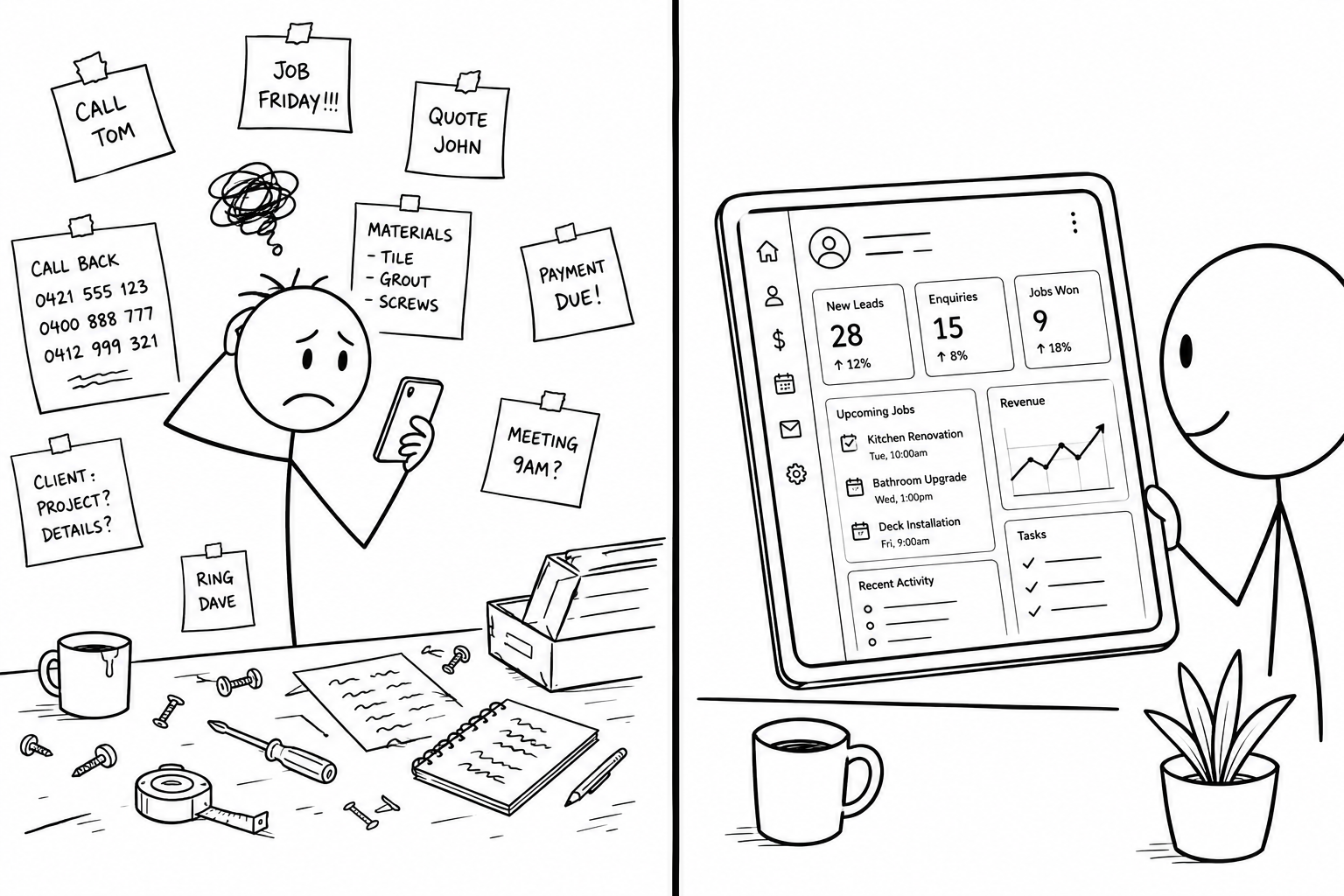
The leads you're losing aren't going nowhere. They're going to whoever called them back first.
Most trades run their business from memory, a few scraps of paper, and a WhatsApp thread they're already behind on. A lead calls while you're on a job. You write the number on your hand. You get back to the van, it's washed off. Lead gone. Job gone.
Sound familiar?
That's not disorganised. That's just what happens when you're trying to run a business without a system. And it's costing you more than you think.
In this article:
What does CRM actually mean?
CRM stands for Customer Relationship Management.
Ignore the corporate jargon. For a trade business it means one simple thing. A single place where every lead, every customer, and every conversation lives. So nothing gets lost, nothing gets forgotten, and you always know exactly where each job is up to.
That's it. No complicated software. No spreadsheets with seventeen tabs. Just one place that tells you what's happening and what needs doing next.
The sticky note and spreadsheet problem
Here's what most trades are actually working with.
Lead comes in through the website, buried in an email inbox. Another one calls while you're on a roof, scribbled on a bit of wood. Someone messages on Facebook, seen, never replied to.
Three leads. All came in the same day. One maybe gets called back. Two disappear.
Some trades try to fix this with a spreadsheet. And a spreadsheet is better than nothing but it doesn't follow up for you. It doesn't send a text when someone enquires at 9pm. It doesn't remind you to chase the quote you sent two weeks ago. It just sits there, quietly judging you.
The leads you're losing aren't going nowhere. They're going to whoever called them back first.
What a proper CRM actually does for a trade business
A CRM built for trades isn't just a fancy contacts list. When it's set up properly, it does the work you don't have time to do.
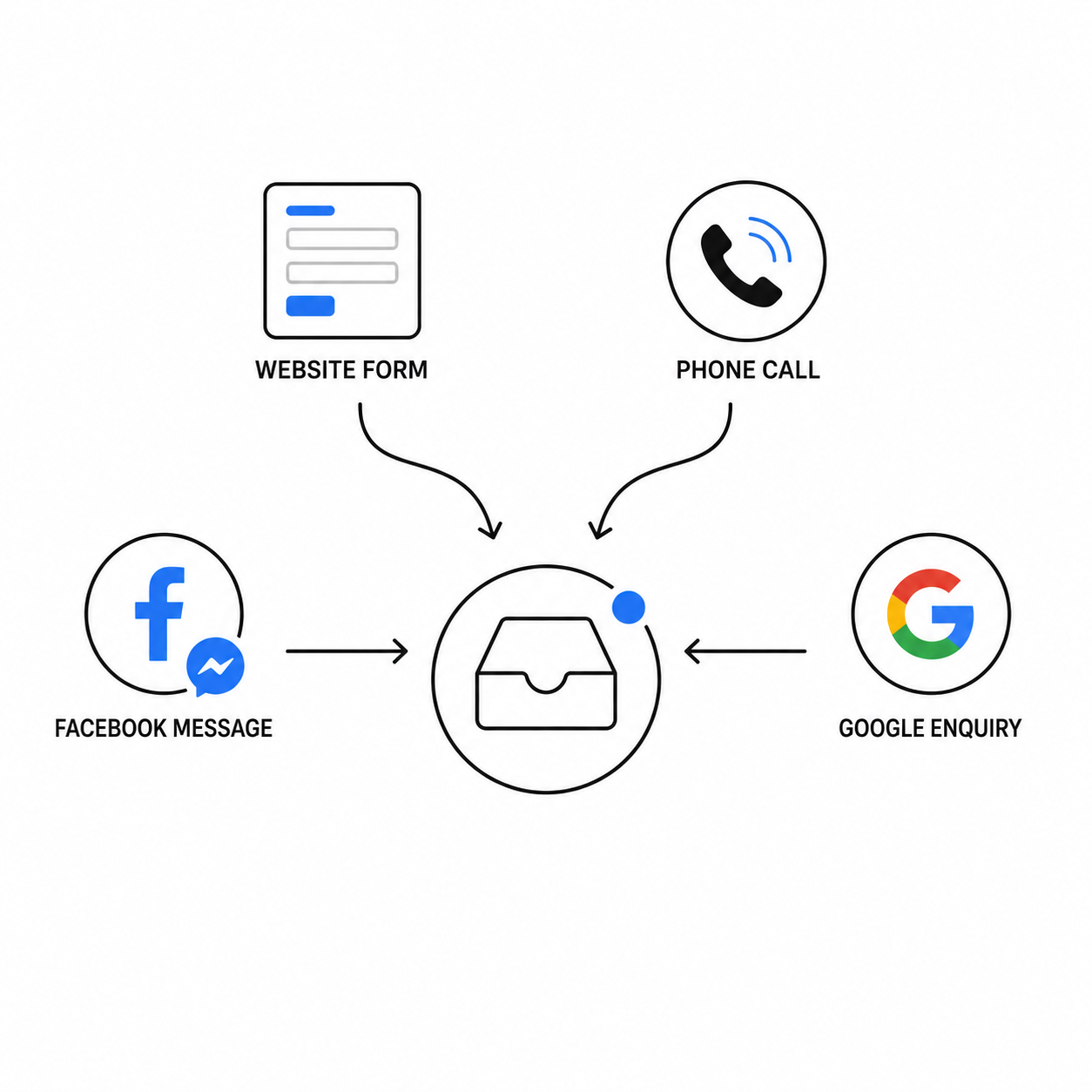
Every lead lands in one place, whether it came from your website, a phone call, a Facebook message, or a Google enquiry. Nothing slips through.
Follow-up happens automatically. Someone fills in your contact form at 11pm, they get an instant text back. You miss a call on a job, they get a message within seconds. You finish a job, a review request goes out 24 hours later without you touching anything.
You can see your entire pipeline at a glance. Who needs a quote. Who's waiting on a callback. Who's ready to book. Instead of trying to hold it all in your head, you've got a dashboard that tells you exactly what needs doing and when.
That's the difference between reacting to your business and running it.
You don't need complicated software
Most CRM tools are built for corporate sales teams. They're bloated, confusing, and require someone whose full-time job is managing the system.
That's not what you need.
You need something straightforward. Something that works in the background while you're on the tools. Something that doesn't require a training course to figure out.
The all-in-one inbox at Chrisp Design does exactly this. Every message, WhatsApp, email, Facebook, website enquiry, SMS, lands in one place. You reply from one place. Your automated follow-ups run on their own. You always know where every lead is up to.
One system. No juggling five different apps. No leads falling through the gaps.
What changes when you have this in place
Before, leads come in from five different places, you keep up with some of them, others go cold, you're not sure how many jobs you're actually losing.
After, every lead is captured, followed up automatically, and tracked from first contact to booked job. You finish a job and a review request goes out without you thinking about it. You wake up and you know exactly what needs doing that day.
It doesn't make you busier. It makes what you're already doing work properly.
"Most trades aren't losing jobs because their work isn't good enough. They're losing them because a competitor followed up faster, and they had a system to make sure that happened every single time."
Key takeaways
- A CRM is simply one place where every lead, customer, and conversation lives, nothing gets lost and nothing gets forgotten
- Most trades are losing leads daily without realising it, those leads aren't disappearing, they're booking with whoever responded first
- A proper CRM automatically follows up with new leads, missed calls, and completed jobs without you doing anything manually
- You don't need complex software, you need one simple system that works in the background while you get on with the job
- The all-in-one inbox at Chrisp Design brings every message channel into one place and runs your follow-up automatically

Find our guides useful? Add Chrisp Design as a preferred source on Google to see more of our articles in your search results.
Add as preferred source on Google